
on 25/05/2026
Written by Andy Stone, Australian Science & Mathematics School
Microbiology can be a challenging area for students to connect with; by its nature, it explores a world they cannot see. The Phage Hunters elective was designed to bridge that gap, allowing students to investigate the invisible world through authentic, research-based learning, while contributing to real scientific discovery.
Delivered as a 4-week elective for Year 10 and 11 students (four 100-minute sessions per week), the program combines core biological concepts with hands-on laboratory work and bioinformatics. It aligns strongly with Stage 1 Biology understandings, inquiry skills, and SHE concepts while also developing key scientific capabilities and learner dispositions.
At the centre of the program are bacteriophages, viruses that infect bacteria. Students explore both the biology of phages and their growing significance in areas such as phage therapy, where they are being investigated as alternatives to antibiotics in the face of increasing antimicrobial resistance. This real-world context provides a compelling entry point, connecting classroom learning to global scientific challenges.
A key strength of the program is its partnership with researchers and institutions. The elective was developed in collaboration with Flinders University Professor Robert Edwards, with support from his research team. Students also engaged with external expertise in bioinformatics and data analysis, ensuring that the science students' work reflects current practices and connects directly to ongoing research.

Building some model phages in the early stages of the project
The program is structured as a progression from foundational knowledge to increasingly sophisticated scientific practice. In Week one, students are introduced to phages, their applications, and the science behind phage therapy, including both its potential and its limitations. This early focus helps students understand the broader significance of their work.
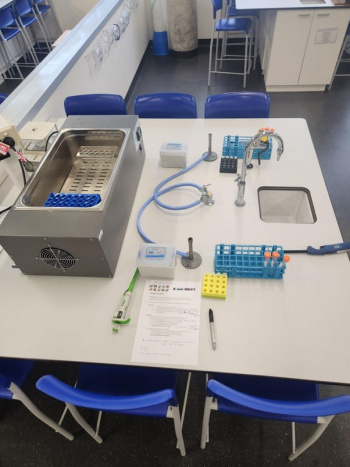
Weeks two and three shift into practical laboratory work. Students develop aseptic techniques and learn how to isolate phages from soil and water environmental samples. Using bacterial hosts including E. coli and S epidermidis, they conduct phage assays, identify plaques (clear zones indicating bacterial lysis), and isolate pure phage samples. building both technical competence and persistence.

Results from the first stages of phage isolation, with clear regions showing the presence of no bacterial growth due to the presence of phages
A defining feature of the program is the transition from school laboratory work to professional scientific environments. Students extract and barcode phage DNA before visiting Flinders University to have their samples sequenced. Working alongside researchers and interacting with early-career scientists gives students insight into real scientific pathways and helps demystify STEM careers.
In the final week, students are introduced to bioinformatics. Using online tools adapted from the Bacterial and Viral Bioinformatics Resource Centre (BV-BRC), students assemble DNA sequences, identify similar genomes, annotate genes, and construct phylogenetic trees. This allows students to engage with large-scale data and transform raw biological information into scientific knowledge.
What sets Phage Hunters apart is the authenticity of the research. Across two classes, 49 phages were successfully isolated, with 27 suitable for bioinformatics analysis, and every single phage identified was novel. This was a powerful moment for students, the realisation that they are not just learning about science, but actively contributing to it. This culminated in our students presenting at the Australian Computational Biology and Bioinformatics Student Society Conference and winning a People's Choice Award
The impact on student engagement and learning was significant. The open-ended nature of the investigation fosters curiosity and resilience. The integration of practical work, theory, and data analysis also supports deeper conceptual understanding, particularly in areas such as genetics and molecular biology.
Assessment within the program reflects this balance. Students explore the societal implications of phage therapy through SHE tasks, while also completing an investigation into phage isolation and characterisation, linking each step of their method to underlying scientific concepts. The inclusion of bioinformatics provides further opportunities for data analysis and evidence-based reasoning.
Importantly, the program is highly adaptable. While it ran as an intensive elective, elements of Phage Hunters, such as phage isolation or bioinformatics analysis, can easily (and cheaply) be incorporated into existing courses. The combination of hands-on experimentation and real-world relevance makes it a valuable model for engaging students in contemporary science, and we are willing to share our materials to support other sites in exploring these opportunities.
Ultimately, Phage Hunters demonstrates what is possible when students are allowed to do genuine scientific work. Through strong partnerships, students are supported to step into the role of scientists, investigating the unseen microbial world and contributing to our collective understanding of it.

We were lucky enough to be recognised by the Advertiser for this work, with this article appearing on 19/11/2025.
Special thanks to Prof Rob Edwards and his team (Flinders University) for guidance and support before, during, and after this project, Assoc Prof Rebecca Wattam (University of Virginia) and Prof Ramy Aziz (Cairo University), for support in adapting BV-BRC for classrooms, and George Bouros (Adelaide University) for his support in additional bioinformatics analysis and conference preparation.
For access to lesson resources and presentations, practical and bioinformatics methods and task sheets, please contact andrew.stone@asms.sa.edu.au.
Share:


