
on 09/09/2026
by Denise Rule, Manager STEM Programs, Department for Education
What happens when hundreds of Aboriginal young people come together for two days to explore science, technology, engineering and mathematics?
There is plenty of noise, energy and curiosity, but there is also something much more important happening.
The 2026 STEM Aboriginal Learner Congress brought together over 800 Aboriginal students from 187 South Australian public schools at Adelaide Oval on Kaurna Country for two days of hands-on STEM learning, connection and celebration. Students travelled from across the state to take part, with some journeying hundreds of kilometres from communities in the APY Lands, Coober Pedy and Port Lincoln.
Under this year's theme, All in: Culture and Future, students explored STEM through workshops, demonstrations and conversations led by Aboriginal STEM professionals, educators and community members, alongside universities, industry and partner organisations.
They analysed DNA, explored astronomy and space, investigated animal skulls, experimented with coding, engineering and geoscience, considered architecture and submarines, and explored food science through preparing kangaroo chilli con carne.
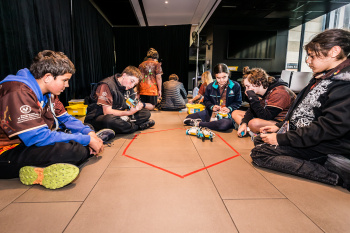
Photo 1 (above): Students programming LEGO robots during a hands-on STEM workshop.

Photo 2: Students exploring genetics through interactive exhibits from MOD. (Museum of Discovery).
But Congress is about much more than providing students with a collection of exciting STEM activities.
Across the two days, students heard from Aboriginal people working, studying, leading and creating across STEM fields. Their stories showed that there isn't one pathway into STEM and that STEM knowledge and careers can connect with Culture, Country, community and individual interests.
Congress also deliberately creates opportunities for students to see themselves not just as participants in STEM, but as people who can shape its future.
One of the strongest examples is the Young Aboriginal STEM Thinkers of South Australia (YASTSA) program, which places Aboriginal student voice and leadership at the heart of Congress.
Throughout 2026, students from 16 YASTSA schools contributed to the design and delivery of Congress, bringing their ideas, experiences and perspectives to the event. At Congress, these young people stepped into leadership roles: welcoming and supporting other students, helping facilitate workshops and activities, speaking on stage and sharing their own experiences of STEM.
One Year 12 YASTSA mentor reflected on how being involved over several years had helped shape their own aspirations:
“Being part of STEM Congress has narrowed what career I want to do. When I was in Year 7, I didn't know what I wanted to do. Now I want to run my own roaming clinic to help rural Indigenous people get health care.”
 |
 |
| Photo 3: YASTSA students taking the stage on Day 2 of the STEM Aboriginal Learner Congress. | Photo 4: A YASTSA mentor supporting younger students on stage during Congress. |
Peer leadership became one of the defining features of the event.
Leadership did not always look like standing on a stage. Sometimes it was explaining an activity to another student, helping someone find their way, encouraging a younger learner to have a go, or confidently starting a conversation with a STEM professional.
 |
 |
| Photo 5: Students collaborating on a hands-on STEM engineering challenge. | Photo 6: A YASTSA student leading and supporting fellow students during the YASTSA shelter-building workshop. |
Congress also provides an opportunity to challenge the idea that STEM exists separately from Culture.
Aboriginal knowledges have been developed, practised and shared across generations and are deeply connected to Country, community and place. Congress creates opportunities for students to explore connections between Aboriginal knowledges and contemporary STEM, while recognising the distinct knowledge traditions, perspectives and practices each brings.
It also challenges the assumption that STEM knowledge exists only within Western scientific traditions and opens up richer conversations about different ways of knowing, thinking, observing and responding to the world.
For teachers, there is an important message here too.
Creating meaningful STEM experiences for Aboriginal learners isn't simply about adding an Aboriginal context to an existing activity. It requires relationships, representation and student voice, alongside genuine engagement with local Aboriginal communities, knowledges and Country. It also means creating learning environments in which Aboriginal young people's knowledge, perspectives and identities are recognised, respected and valued.
 |
 |
| Photo 7: A YASTSA teacher connecting with a STEM professional and Boandik Elder during Congress. | Photo 8: An Aboriginal undergraduate medical student yarning with students at Congress. |
Curiosity is a powerful starting point
Perhaps one of the best measures of Congress isn't the number of workshops delivered or students attending.
It's the conversations that happen during the event and afterwards.
A student wanting to know more about genetics after analysing DNA. Someone discovering a STEM career they had never heard of. A young person recognising themselves in the story of an Aboriginal scientist, engineer or university student. A YASTSA mentor beginning to imagine how STEM might enable them to give back to their community. A teacher returning to school with a new idea or connection.
We hope Congress supports more Aboriginal young people to see STEM as something they can participate in, influence and, if they choose, pursue through further learning and careers.
Not every student who attends will choose that path, nor is that the only measure of success. Every student can leave with something: greater curiosity and confidence, new connections, and a broader sense of the possibilities STEM can offer.
For STEM educators, there is an important role for us in continuing this work in our classrooms.
How do we create STEM learning in which Aboriginal learners, knowledges and perspectives are genuinely represented and valued?
How often do our students encounter Aboriginal STEM professionals and contemporary role models?
And where can we make more space for students themselves to lead the learning?
Next year marks 10 years of Congress, which began in 2017 with 104 curious students and has grown into a statewide celebration connecting Aboriginal young people with STEM.
The 2026 STEM Aboriginal Learner Congress showed what can happen when Culture, community, education and STEM come together, and when Aboriginal young people have genuine opportunities not only to participate, but to contribute, lead and shape what comes next.
All in.
Denise Rule is a science and STEM education leader with experience across teaching, curriculum and statewide STEM programs. She currently manages STEM Programs with the South Australian Department for Education, including STEM scholarships and the STEM Aboriginal Learner Congress. Denise is particularly interested in equity, student voice and creating opportunities for young people to participate, lead and see new possibilities for themselves through STEM.
Share:


